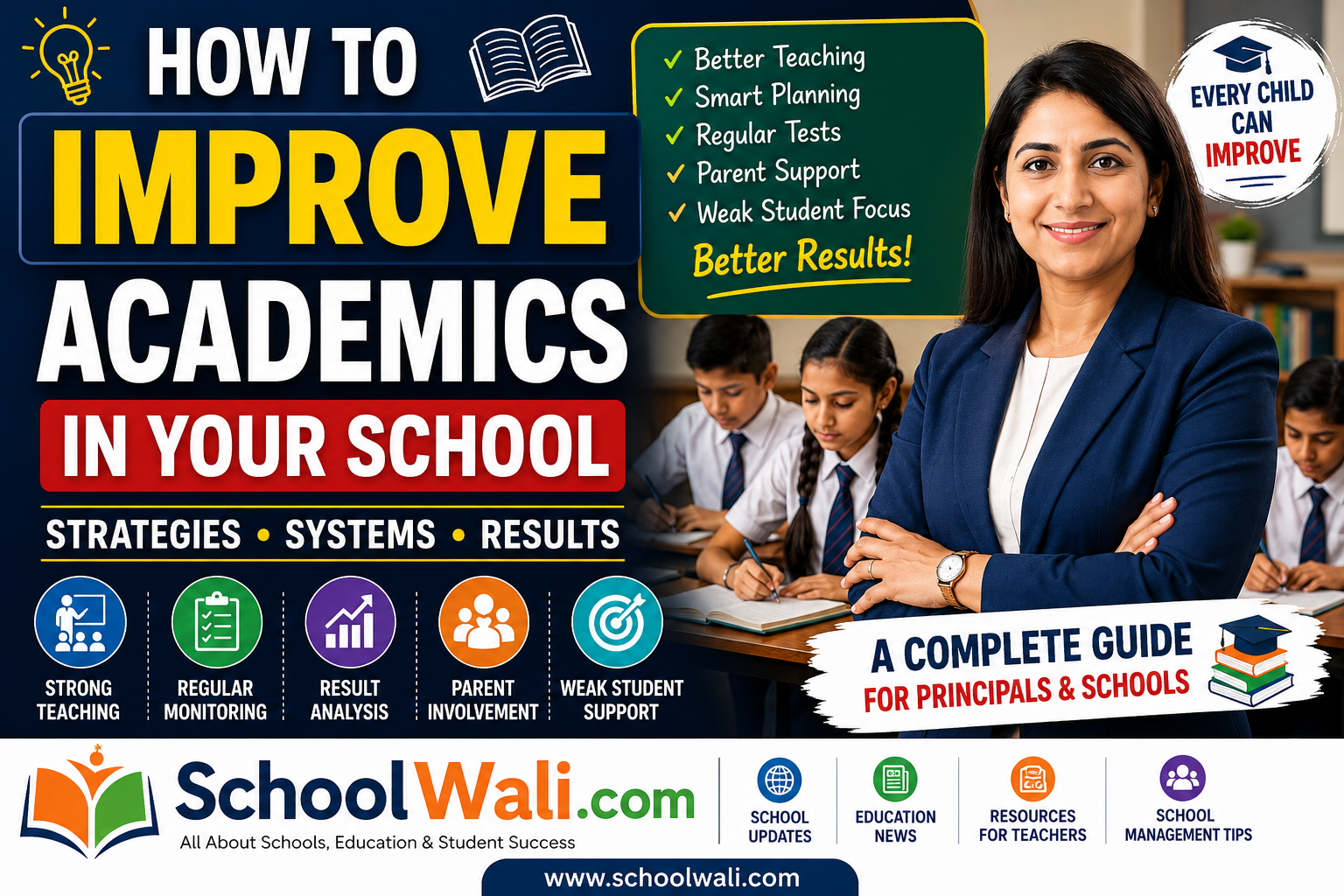
Good academics are the foundation of every successful school. Parents trust schools that consistently deliver strong academic performance, disciplined classrooms, and visible student improvement. Whether a school is small or well-established, improving academics requires proper planning, monitoring, teacher accountability, and student support.
Many schools focus only on completing the syllabus, but truly successful schools build systems that improve learning outcomes month after month.
In this article, we will understand practical and effective ways to improve academics in school through better teaching methods, result analysis, student support systems, and academic management.
Why Academic Improvement Matters in Schools
Strong academics help schools in many ways:
- Improve student confidence
- Increase board exam results
- Build school reputation
- Increase admissions
- Improve parent satisfaction
- Create disciplined learning culture
- Help students perform better in future careers
Schools with strong academic systems automatically attract more parents and better teachers.
1. Create a Clear Academic Vision
Every school should have a clear academic goal.
Ask these questions:
- What type of academic culture do you want?
- Is your school result-oriented?
- Do you focus on conceptual learning?
- Are you preparing students for competitive exams?
- Do you want better English communication?
A clear vision helps teachers and students work toward a common target.
Example Academic Vision
“Every child should show measurable academic improvement every month.”
When schools operate with a clear vision, academic performance becomes more organized and focused.
2. Improve Teacher Quality and Accountability
Teachers are the backbone of school academics.
Even the best infrastructure cannot improve results if classroom teaching is weak.
Important Teacher Responsibilities
Teachers should:
- Prepare lesson plans
- Complete syllabus on time
- Conduct regular tests
- Check notebooks properly
- Encourage classroom participation
- Support weak students
- Maintain discipline
Introduce Teacher KPIs
Schools should track teacher performance using Key Performance Indicators (KPIs).
Teacher KPIs May Include:
- Class results
- Syllabus completion
- Student engagement
- Homework checking
- Attendance
- Parent feedback
- Improvement in weak students
Regular monitoring increases teacher accountability and consistency.
3. Conduct Regular Classroom Observations
Principals should regularly visit classrooms.
This helps identify:
- Teaching quality
- Classroom discipline
- Student participation
- Communication skills
- Weak teaching methods
What to Observe During Classroom Visits
Check whether:
- Students are attentive
- Teachers explain concepts clearly
- Blackboard work is neat
- Weak students are involved
- Questions are encouraged
- English communication is improving
Best Practice
Observe:
- 2–3 classes daily
- 10–15 minutes each
Maintain observation records for future review.
4. Build a Strong Testing Culture
Regular testing improves student seriousness and academic performance.
Schools should not wait for final exams to evaluate students.
Types of Tests Schools Should Conduct
Weekly Tests
Help students revise regularly.
Monthly Assessments
Track overall academic progress.
Surprise Tests
Improve attentiveness and preparation.
Oral Tests
Improve confidence and speaking skills.
MCQ-Based Tests
Prepare students for competitive exams.
Focus on Understanding, Not Memorization
Good tests should evaluate:
- Concept clarity
- Writing skills
- Presentation
- Time management
- Application-based learning
5. Create a Weak Student Improvement System
One of the biggest reasons schools struggle academically is ignoring weak students.
Every school should identify students who need extra academic support.
Student Categorization System
Schools can divide students into categories:
- A Grade – Top performers
- B Grade – Average students
- C Grade – Weak students
- D Grade – Critical support needed
Strategies for Weak Students
Extra Classes
Conduct additional revision sessions.
Parent Meetings
Keep parents informed about academic progress.
Daily Monitoring
Track homework and attendance carefully.
Peer Support
Pair weak students with good performers.
Oral Revision
Improve confidence through oral questioning.
Weak student tracking can significantly improve overall school results.
6. Improve Classroom Discipline
No academic system can succeed without discipline.
A disciplined classroom creates a better learning environment.
Important Discipline Areas
- Teacher punctuality
- Student attendance
- Uniform discipline
- Homework submission
- Silence during teaching
- Proper seating arrangements
Benefits of Classroom Discipline
- Better concentration
- Improved learning speed
- Reduced distractions
- Better teacher control
- Improved academic results
7. Strengthen Homework and Notebook Checking
Homework helps students practice concepts learned in class.
However, homework is effective only when it is checked properly.
Good Homework Practices
Homework should:
- Be meaningful
- Improve writing practice
- Be checked regularly
- Encourage thinking
- Match classroom teaching
Avoid These Mistakes
- Excessive copying work
- Unchecked notebooks
- Very difficult homework
- Irregular homework schedules
Notebook checking should be systematic and monitored by coordinators or principals.
8. Improve English Communication in School
Strong communication skills improve student confidence and future opportunities.
Even schools in small towns can create an English-speaking environment.
Simple Ways to Improve English Skills
Word of the Day
Teach one new word daily.
Morning Assembly Speaking
Encourage students to speak in assembly.
Classroom Presentations
Improve confidence and communication.
English Speaking Hours
Create dedicated English communication periods.
Reading Activities
Encourage newspaper and story reading.
Consistency is more important than perfection.
9. Conduct Academic Review Meetings
Schools should regularly review academic performance.
Weekly Academic Meetings
Discuss:
- Syllabus completion
- Weak chapters
- Student performance
- Teacher challenges
- Discipline issues
Monthly Academic Reviews
Analyze:
- Subject-wise performance
- Section-wise results
- Weak students
- Attendance patterns
- Teacher effectiveness
Academic meetings help schools solve problems before they become serious.
10. Use Result Analysis to Improve Performance
Result analysis is one of the most powerful academic improvement tools.
Many schools only announce results without studying the reasons behind performance.
What to Analyze
- Subject averages
- Highest and lowest marks
- Pass percentages
- Chapter-wise weakness
- Student improvement trends
- Teacher performance
Important Result Categories
Topper List
Recognize high performers.
Improvement List
Appreciate students who improved.
Concern List
Identify students needing support.
Result analysis helps schools make better academic decisions.
11. Build Strong Parent Communication
Parents play an important role in student success.
Schools should maintain regular communication with parents.
Effective Parent Communication Methods
- Parent-Teacher Meetings (PTMs)
- WhatsApp updates
- Homework alerts
- Attendance notifications
- Academic progress reports
Benefits of Parent Involvement
- Better student discipline
- Improved attendance
- Faster academic improvement
- Increased parent trust
Parents should feel that the school genuinely cares about their child’s future.
12. Create a Smart Timetable
A well-designed timetable improves learning efficiency.
Timetable Best Practices
- Keep Maths and Science in morning periods
- Avoid difficult subjects at the end of the day
- Balance teacher workload
- Give preparation periods to teachers
- Assign strong teachers to weak sections
A balanced timetable reduces fatigue and improves concentration.
13. Use Technology for Academic Management
Modern schools should use digital tools to improve academic efficiency.
Useful Academic Technologies
School ERP Software
Manage:
- Attendance
- Fees
- Homework
- Results
- Parent communication
Smart Classes
Improve concept understanding through visuals.
Online Tests
Track performance quickly.
Digital Result Analysis
Generate reports and performance insights.
Technology helps schools save time and improve management accuracy.
14. Motivate Students Through Recognition
Students perform better when their efforts are appreciated.
Ways to Motivate Students
- Certificates
- Wall of fame
- Morning assembly appreciation
- Social media recognition
- Class awards
- Improvement awards
Recognition creates healthy competition and motivation.
15. Develop Leadership Monitoring Systems
Principals and school owners should monitor academics daily.
Daily Academic Checklist for Principals
Check:
- Teacher attendance
- Class discipline
- Homework checking
- Syllabus progress
- Weak student attendance
- Classroom engagement
Daily monitoring prevents academic problems from growing.
16. Focus on Concept-Based Learning
Students should understand concepts instead of memorizing answers.
Concept-Based Learning Improves:
- Problem-solving skills
- Long-term understanding
- Competitive exam preparation
- Student confidence
Teachers should use examples, activities, diagrams, and discussions to explain concepts clearly.
17. Encourage Reading Habits
Reading improves vocabulary, writing skills, comprehension, and communication.
Ways to Build Reading Culture
- Create library periods
- Introduce story reading sessions
- Encourage newspaper reading
- Organize reading competitions
- Recommend age-appropriate books
Students who read regularly usually perform better academically.
18. Conduct Teacher Training Programs
Even experienced teachers need continuous improvement.
Teacher Training Topics
- Classroom management
- Modern teaching methods
- Child psychology
- Digital teaching tools
- Communication skills
- Board exam preparation
Regular training keeps teachers updated and motivated.
19. Maintain Consistency Throughout the Year
Academic improvement is not achieved in a few weeks.
Schools must maintain:
- Regular monitoring
- Consistent discipline
- Timely testing
- Teacher accountability
- Parent communication
Consistency creates long-term academic growth.
Common Mistakes Schools Should Avoid
Many schools struggle academically because of poor systems.
Avoid These Mistakes
- Ignoring weak students
- No classroom observations
- No teacher accountability
- Delayed syllabus completion
- Lack of testing culture
- Poor parent communication
- No result analysis
- Overburdening teachers
Removing these problems can quickly improve academic performance.
Qualities of High-Performing Schools
Successful schools usually:
- Monitor academics daily
- Support weak students
- Conduct regular tests
- Train teachers continuously
- Maintain discipline
- Communicate effectively with parents
- Celebrate achievements
- Analyze results carefully
Academic success comes from systems, consistency, and leadership.
Final Thoughts
Improving academics in school requires proper planning, disciplined execution, and continuous monitoring.
Schools that focus on teacher quality, student support, classroom discipline, regular testing, and parent communication usually achieve excellent results.
Strong academics not only improve student performance but also strengthen the school’s reputation and future growth.
School leaders should build systems that support every student and help teachers perform at their best.
When schools consistently monitor and improve academic processes, long-term success becomes achievable.
Frequently Asked Questions (FAQs)
How can schools improve academic performance quickly?
Schools can improve academic performance by conducting regular tests, monitoring teachers, supporting weak students, improving discipline, and increasing parent involvement.
Why is teacher accountability important?
Teacher accountability ensures that syllabus completion, classroom teaching, homework checking, and student improvement are monitored properly.
How do weak student programs help schools?
Weak student programs provide additional support to struggling students through extra classes, parent communication, and personalized attention.
What is the role of principals in academic improvement?
Principals monitor classrooms, review teacher performance, analyze results, maintain discipline, and ensure academic systems function properly.
Why are regular tests important in schools?
Regular tests improve student seriousness, help identify weaknesses early, and strengthen revision and concept clarity.